This 3-in-1 advanced course bundle is designed for learners who wish to go beyond using pre-built architectures and truly understand how modern transformer-based vision and vision-language models are constructed, trained, and optimized from the ground up. Across these three courses, you will build three foundational architectures that represent some of the most important milestones in computer vision and multimodal AI - the Vision Transformer (ViT), the Nano Vision-Language Model (NanoVLM), and the Data Efficient Image Transformer (DeiT).
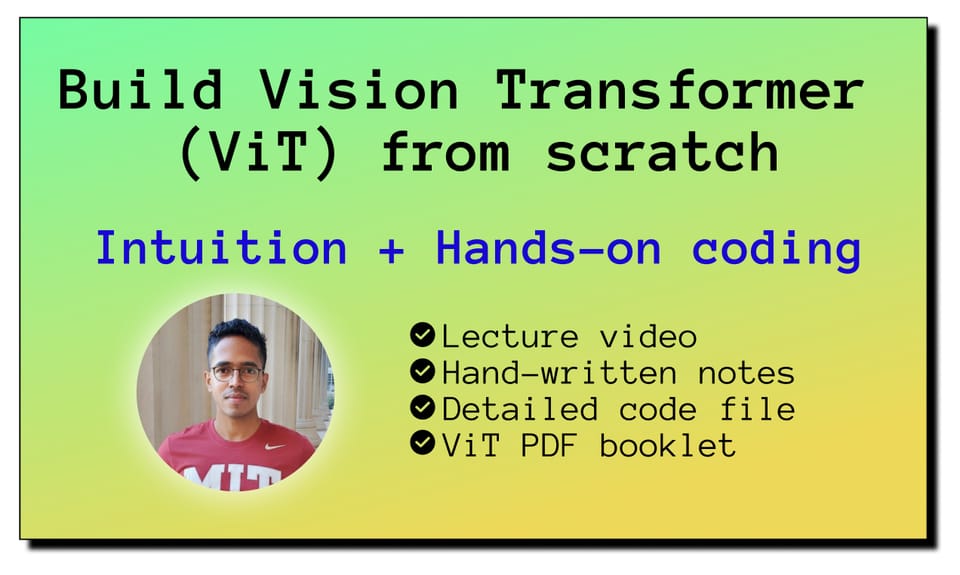
We begin with the Vision Transformer, where you will learn how images are divided into patches, embedded, and passed through transformer encoders to perform image classification. You will implement every single component from scratch, including the patch embedding layer, positional encoding, multi-head self-attention, feed-forward blocks, and the classification head. You will also train your ViT model on a simple dataset to visualize how transformer-based perception evolves compared to CNNs.
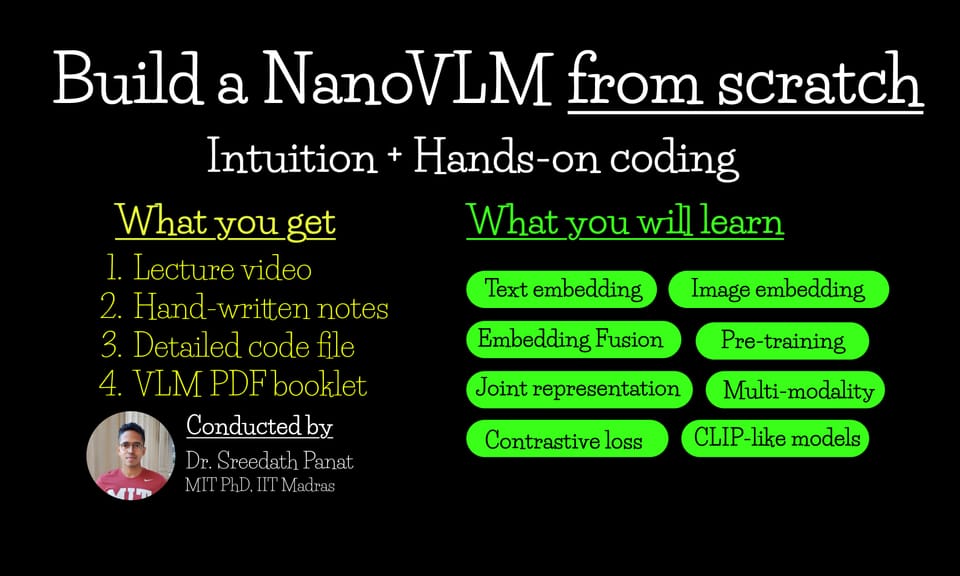
Next, we move to the NanoVLM, a compact but powerful vision-language model. Here, you will understand how to connect an image encoder and a text encoder within a shared embedding space, train them using contrastive loss, and see how models like CLIP, Flamingo, and GPT-4V align visual and textual modalities. You will construct both the encoders and the training pipeline from scratch, building intuition about how such multimodal systems are trained in practice.
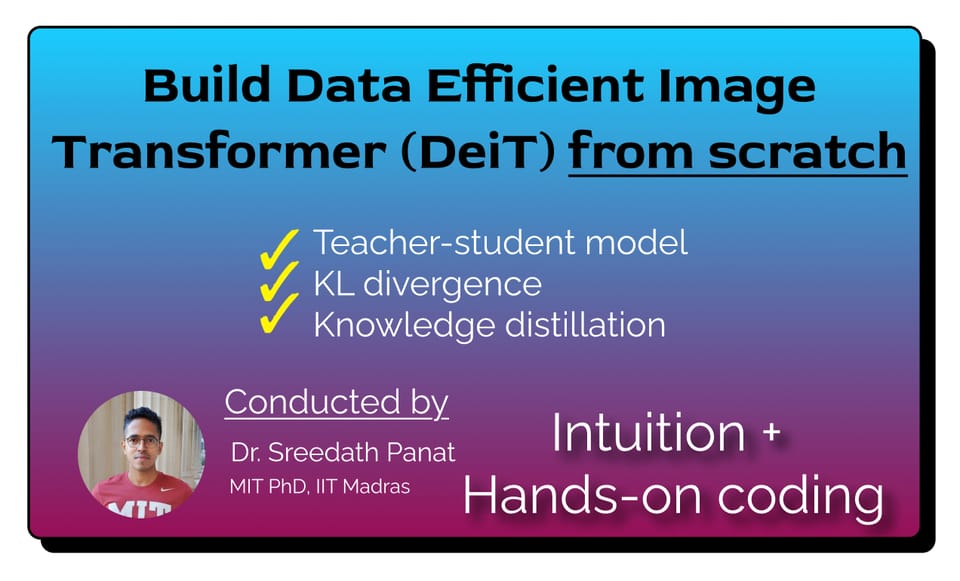
Finally, in the Data Efficient Image Transformer (DeiT) module, you will explore how knowledge distillation helps transformer models train effectively even with limited data. You will implement a ResNet-based teacher network and a Vision Transformer student, set up both hard and soft distillation processes, and train them on a small dataset to observe the efficiency gains. This section ties together everything you’ve learned by combining vision transformers, distillation mechanisms, and optimization strategies used in large-scale production-grade models.
By the end of this bundle, you will not only have built three state-of-the-art architectures entirely from scratch but also gained deep insight into how vision transformers and multimodal models are designed, trained, and improved in real-world AI systems. The knowledge you acquire here will form a strong foundation for advanced work in computer vision, multimodal AI, and model efficiency research.