



AI Engineering Starter Pack by MIT, Purdue PhDs: 12 Courses [FREE] thumbnailRecommended course order

AI Engineering Starter Pack by MIT, Purdue PhDs: 12 Courses [FREE]

By Sreedath Panat

About this bundle

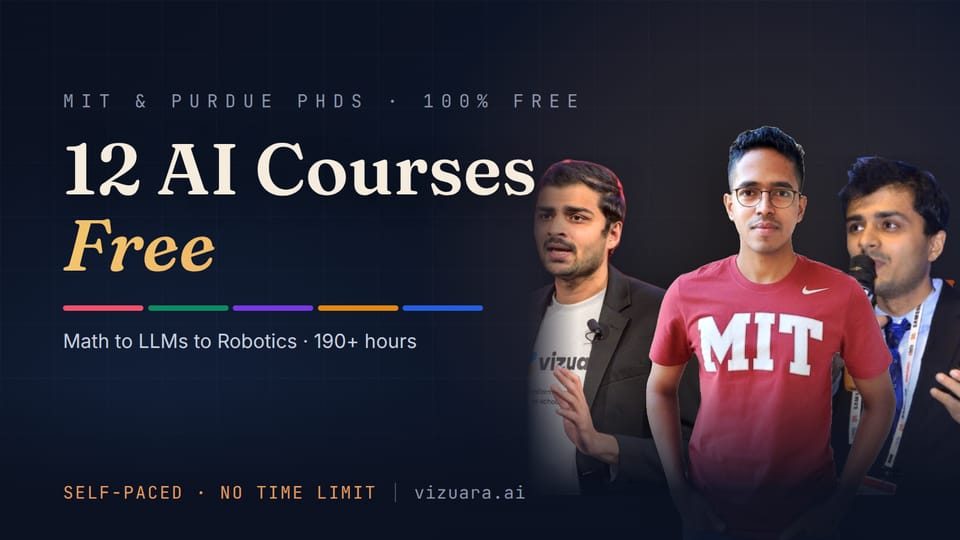
Twelve complete Vizuara courses, more than 190 hours of video, for free.
This is the full path from the mathematics of machine learning to large language models, computer vision and vision-language-action systems, in the order you should learn it. Every course is the complete version with all lecture videos, notes, and notebooks.

Recommended course order

12 courses

Courses are listed in the recommended order. You can take them in any order.

  1. Mathematical Foundations for ML

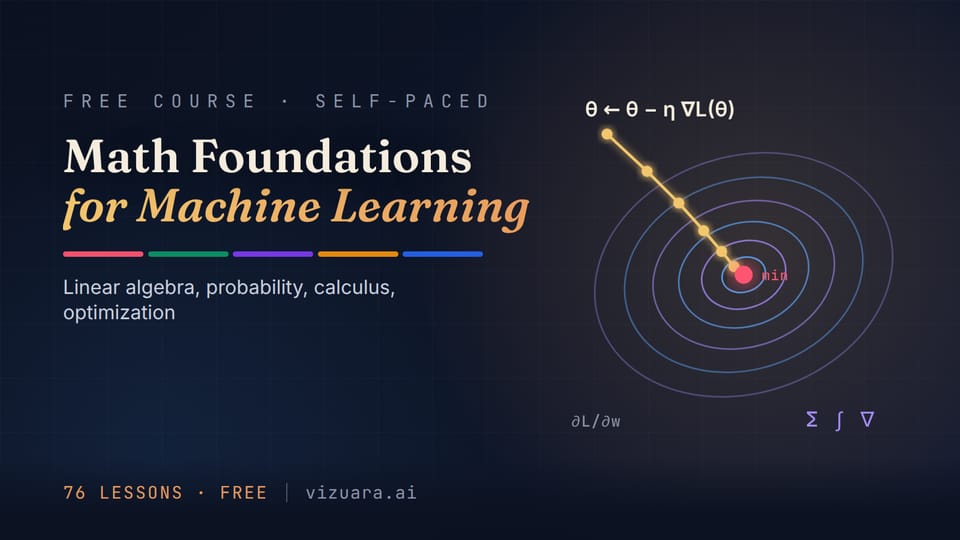
    Every machine learning model is mathematics you can learn in a few weeks. This course teaches exactly the linear algebra, probability, calculus and optimisation that ML actually uses, with visual intuition first and hand-written notes alongside each lecture, so that gradient descent, backpropagation and Bayes' theorem stop being magic words. What you will learn Vectors, matrices and transformations, and why determinants and eigenvectors matter for data Conditional probability, Bayes' theorem, distributions, hypothesis testing and Naive Bayes Derivatives, the chain rule, partial derivatives, gradients and integrals for ML Optimisation from gradient descent to SGD, momentum, RMSprop and Adam Python, NumPy and Pandas foundations, including matrix multiplication from scratch What is included 76 lessons with about 24 hours of video Hand-written notes for the calculus and optimisation modules A closing overview of core ML algorithms and the future of the field Course end test Who it is for Anyone starting machine learning who wants to understand the equations rather than copy them. No prior ML experience needed; school-level mathematics is enough.
    76 lessons 23h 43m
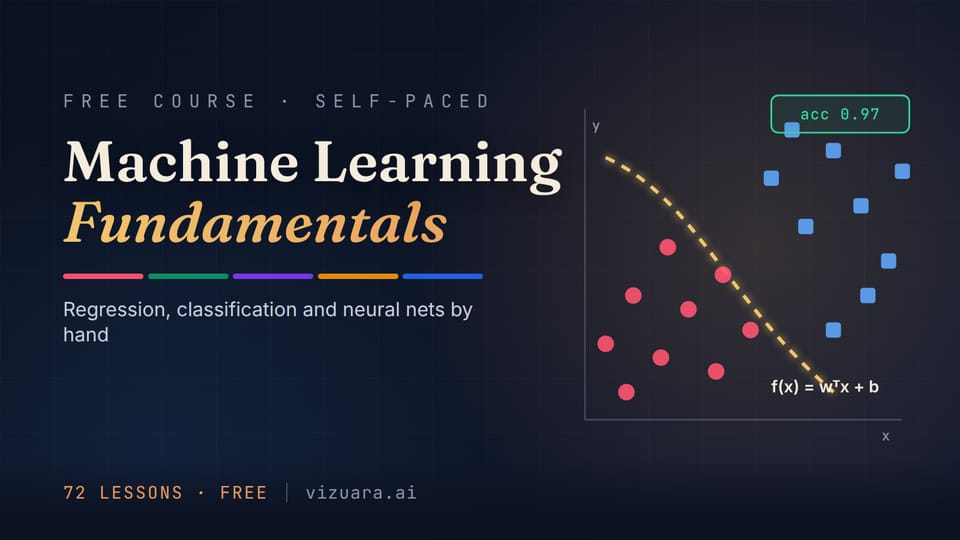
  2. Build Machine Learning Fundamentals

    Learn machine learning by building the models yourself, not by calling a library. Starting from what ML is and the six steps of every ML project, you code linear classifiers, logistic regression, linear and ridge regression and a small neural network from the ground up in Python, and you understand what each parameter is doing. What you will learn The types of ML models and how a real ML project is structured Logistic regression, gradient descent, cross-entropy loss and regularisation, all coded from scratch Linear regression, ordinary least squares and ridge regression with full derivations Neurons, layers, activation functions and backpropagation, ending with hands-on network training What is included 72 lessons with about 19 hours of video Lecture notes for every section Interview-style recaps of classification and regression Course end test Who it is for Beginners with basic Python who want a solid, code-first grounding before moving on to deep learning.

    72 lessons 18h 34m
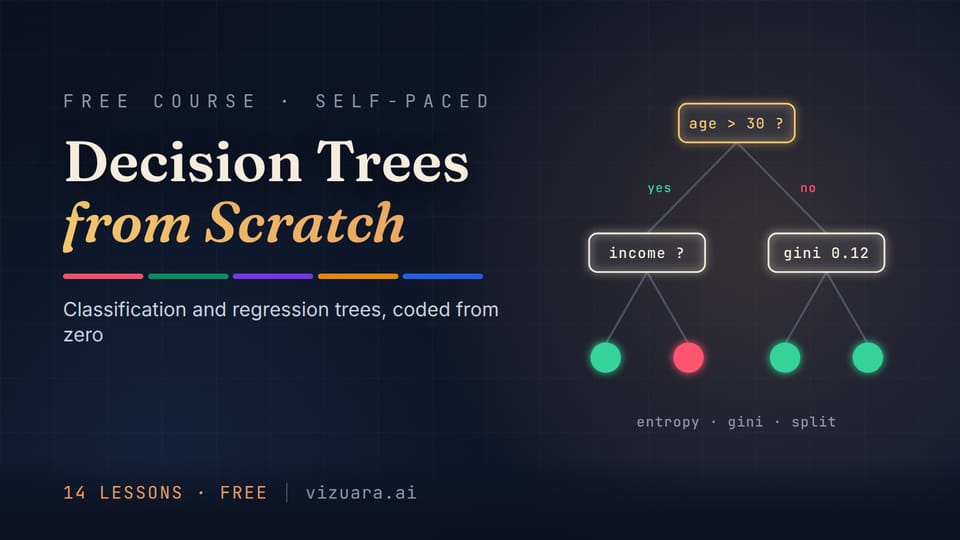
  3. Build Decision Trees From Scratch

    Build classification and regression decision trees from scratch in Python and understand the model behind random forests and gradient boosting. Trees are the most readable models in machine learning, and once you have written one you can reason about any ensemble built on them. What you will learn What a split has to decide and how Gini impurity measures it for categorical and numerical data Growing a full classification tree in code, then pruning it Regression trees from a single feature to many features How to explain trees clearly in an interview What is included 14 focused lessons with about 7 hours of video, all code written live Complete lecture notes Interview preparation summary Course end test Who it is for Learners who know basic Python and want their first complete, from-scratch ML algorithm.

    14 lessons 6h 46m
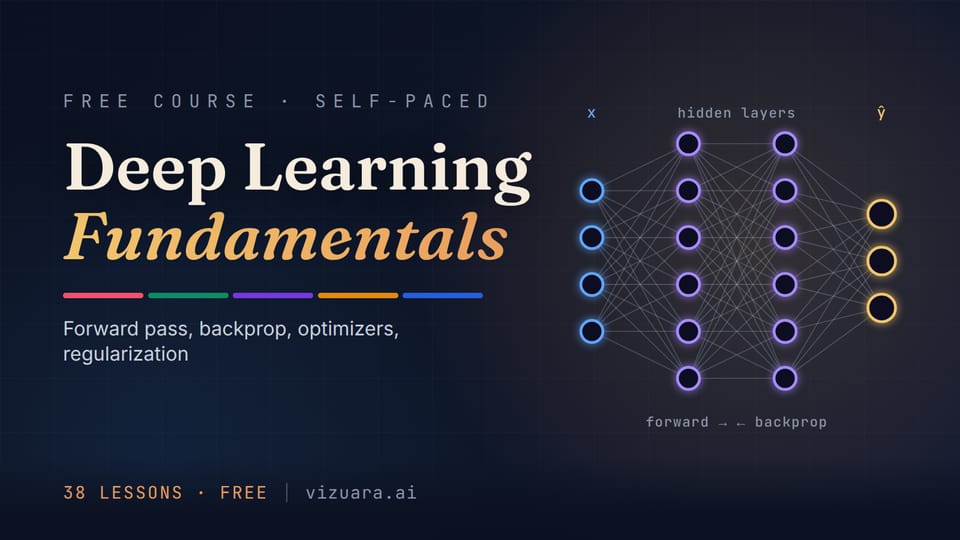
  4. Build Deep learning fundamentals

    Write a complete neural network library in NumPy and understand every line of it. This course follows the same order a framework like PyTorch uses internally: layers, forward pass, loss, backward pass, optimisers, regularisation, then real projects. What you will learn Neurons, dense layers, activation functions and the cross-entropy loss in code Backpropagation derived and implemented through softmax, ReLU and the loss Six optimisers built and compared: gradient descent, momentum, learning-rate decay, Adagrad, RMSProp and Adam Dropout, L1 and L2 regularisation, k-fold cross validation and honest testing Two end-to-end projects: California housing regression and Fashion-MNIST classification What is included 38 lessons with about 18 hours of video Google Colab notebook for every step Detailed lecture notes and a 20-minute summary of the whole series Course end test Who it is for Anyone who has used a deep learning framework and wants to know what happens underneath. Basic Python and NumPy are enough.

    38 lessons 17h 41m
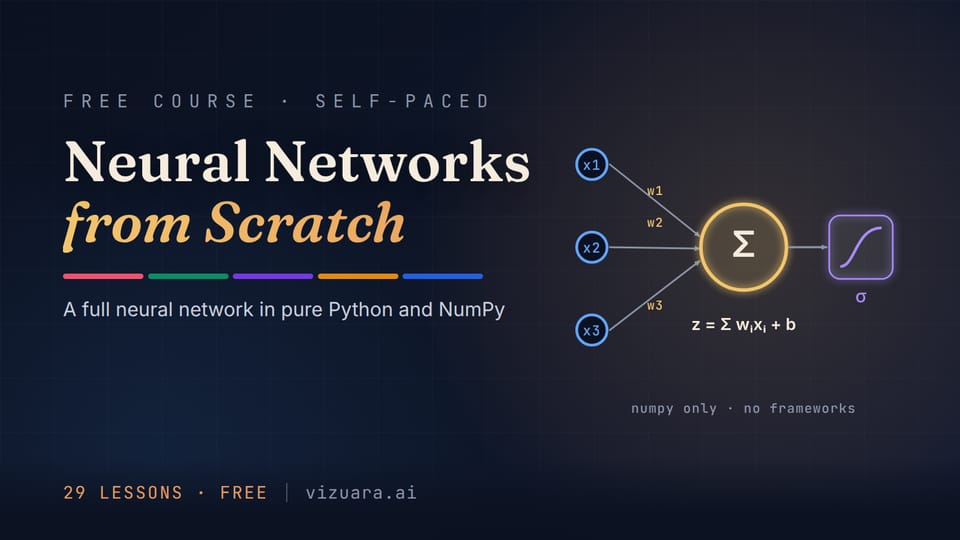
  5. NNFS: Neural Network From Scratch

    A four-hour route to really understanding neural networks, by building one. NNFS opens with ten questions every beginner should be able to answer and closes with a working network that you train and visualise yourself. What you will learn The function that switches a neuron on or off, and matrix multiplication as a classifier Softmax as a probability distribution, tensors, and how weight values are found Designing a layer architecture and implementing the forward and backward pass Activation functions and visualising what the network has learned What is included 29 short lessons in two parts, just under 4 hours of video Course end test Who it is for The ideal warm-up before Deep Learning Fundamentals, or a fast refresher if you have seen neural networks before and want the intuition to stick.

    29 lessons 3h 48m
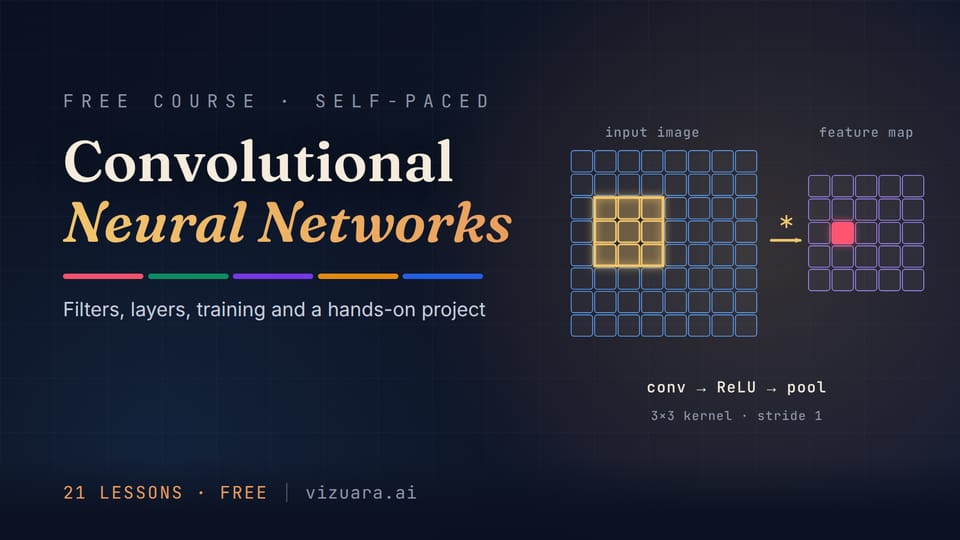
  6. Convolutional neural Networks Fundamentals

    Convolutional neural networks are how computers see. Build one and train it to detect brain tumours in MRI scans. The course starts with the filter, the smallest idea in a CNN, and builds up to a full architecture and a working medical imaging project. What you will learn Filters in one and two dimensions and the convolution operation itself The two building blocks of a CNN: filtering layers and max-pooling layers How the layers stack into a complete CNN architecture How backpropagation flows through a convolutional layer A hands-on brain tumour classification application What is included 21 lessons with about 8 hours of video Complete project walkthrough Course end test Who it is for Learners who have finished a neural networks course and want their first computer vision model.

    21 lessons 7h 49m
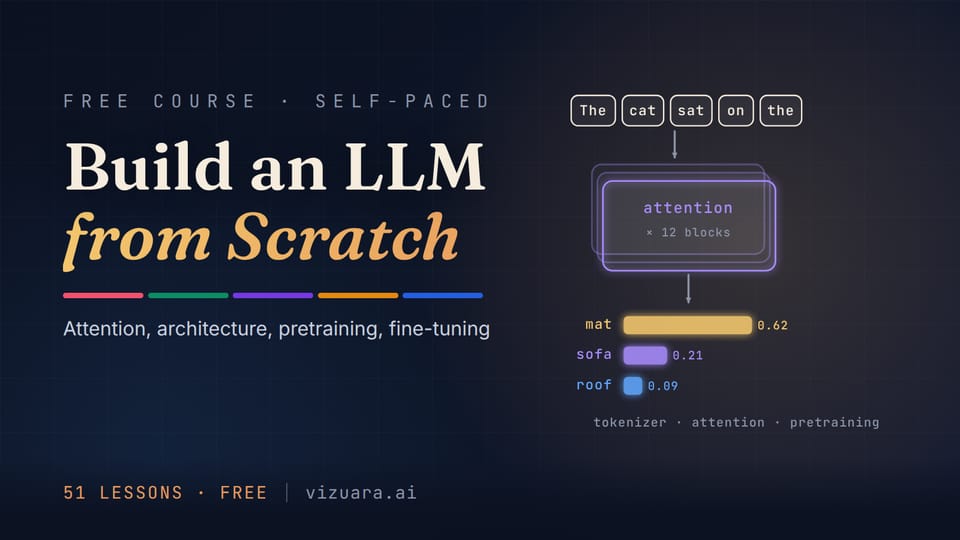
  7. Build Large Language Models (LLMs) from Scratch

    Build a GPT-style large language model from an empty Python file, the same way the frontier labs do it. Vizuara's most popular course walks through all five stages: data preprocessing, attention, architecture, pretraining and finetuning, and by the end you have trained and finetuned your own 124 million parameter GPT-2. What you will learn Tokenisation and byte-pair encoding, input-target pairs, token and positional embeddings Simplified, causal and multi-head attention, coded step by step The full transformer block with layer normalisation, GeLU and shortcut connections The pretraining loop, loss evaluation, temperature scaling and top-k sampling Finetuning twice: a spam classifier and an instruction-following assistant What is included 51 lessons with about 31 hours of video All Google Colab notebooks Seven parts of lecture notes and a 20-minute summary Course end test Who it is for Anyone comfortable with Python and basic neural networks who wants to understand LLMs from the inside rather than only through an API.

    51 lessons 30h 35m
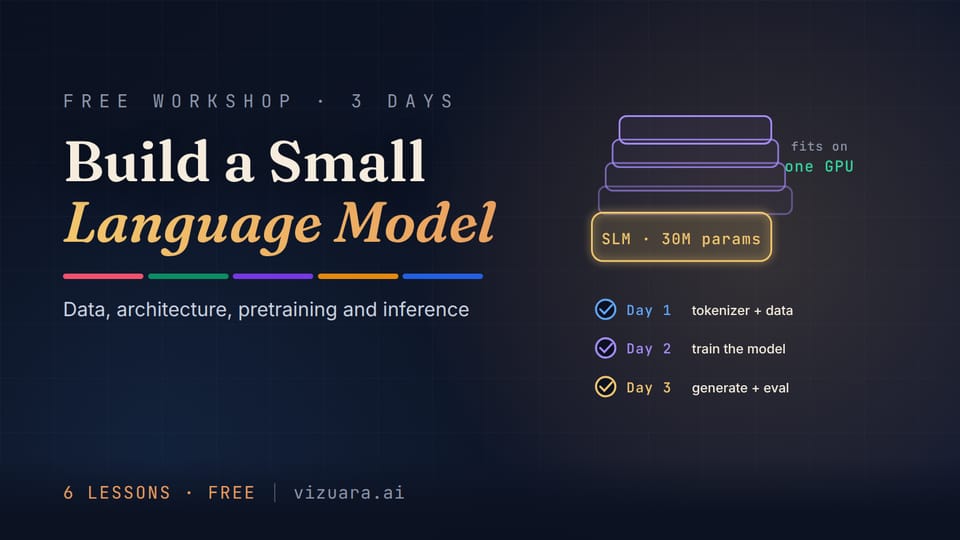
  8. Build SLM from Scratch Workshop [FREE]

    Three workshop days that take you from raw text to a small language model you trained yourself. Each day pairs a full recording with a Google Colab notebook, so you follow along cell by cell and finish with a model that generates text. What you will learn Day one: cleaning, tokenising and batching a text dataset for training Day two: assembling the language model architecture piece by piece Day three: pretraining the model and running inference What is included Three complete workshop recordings, about 5.5 hours in total A Colab notebook for every day Who it is for A compact, hands-on companion to Build Large Language Models from Scratch, good on its own if you want to see the whole pipeline in an afternoon.

    6 lessons 5h 35m
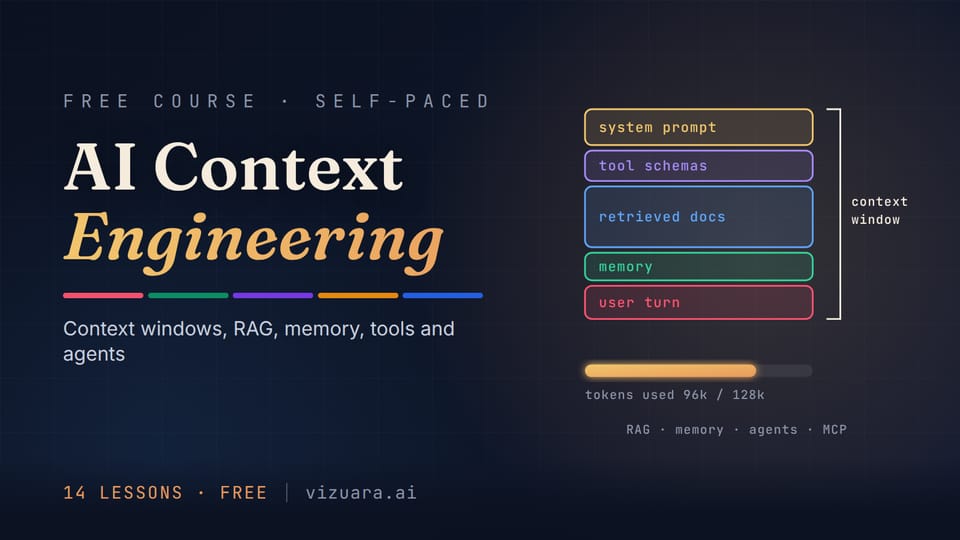
  9. AI Context Engineering [FREE PLAN]

    Context engineering is what separates a demo from a reliable AI application. It is the discipline of deciding what a language model sees: the system prompt, retrieved documents, tool outputs, memory and conversation history that fit inside the context window. This course records ten full sessions on the subject, from foundations to shipping real agents with Claude Code. What you will learn Foundations of context and the instructional layer of system prompts Retrieval-augmented generation from scratch: build your own chatbot The Model Context Protocol (MCP) and multi-agent context management with AGENTS.md Memory management for long-running agents Agents that work while you sleep: Claude Code, OpenClaw, Telegram and EC2 An email reply agent from scratch, modern software development with Claude Code, and voice agents What is included Ten recorded sessions, about 24 hours of video Sessions nine and ten with Dr. Raj Dandekar Who it is for Developers and builders who already call an LLM API and want their applications to be dependable.

    14 lessons 23h 43m
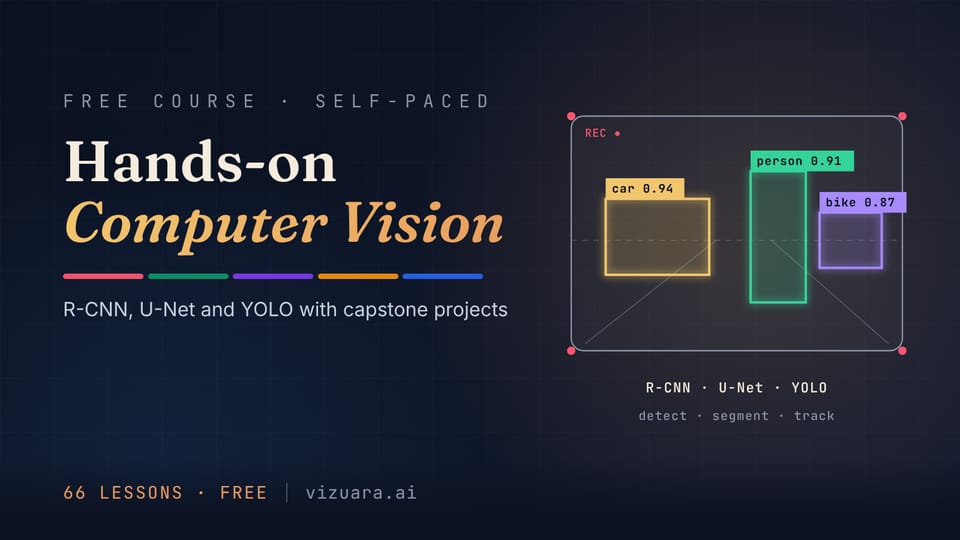
  10. Hands-on Computer Vision Bootcamp [Basic]

    Two full hands-on sessions that get you building with OpenCV and YOLO, plus the complete roadmap of a computer vision bootcamp. The first session introduces computer vision and OpenCV from reading an image to building a mini drawing app. The second builds a real object tracking and counting application with OpenCV and YOLO. What you will learn Reading, displaying and writing images, colour spaces, and OpenCV basics Object tracking and counting with OpenCV and YOLO The vocabulary of detection and segmentation: IoU, mAP, COCO and Pascal VOC formats The bootcamp roadmap through R-CNN, U-Net, YOLOv8 and Roboflow deployment, each with a capstone project outline What is included Two recorded sessions, about 3 hours of video A structured syllabus of the full bootcamp with project briefs Who it is for Beginners in computer vision who want to get their hands on OpenCV and YOLO quickly.

    74 lessons 14h 9m
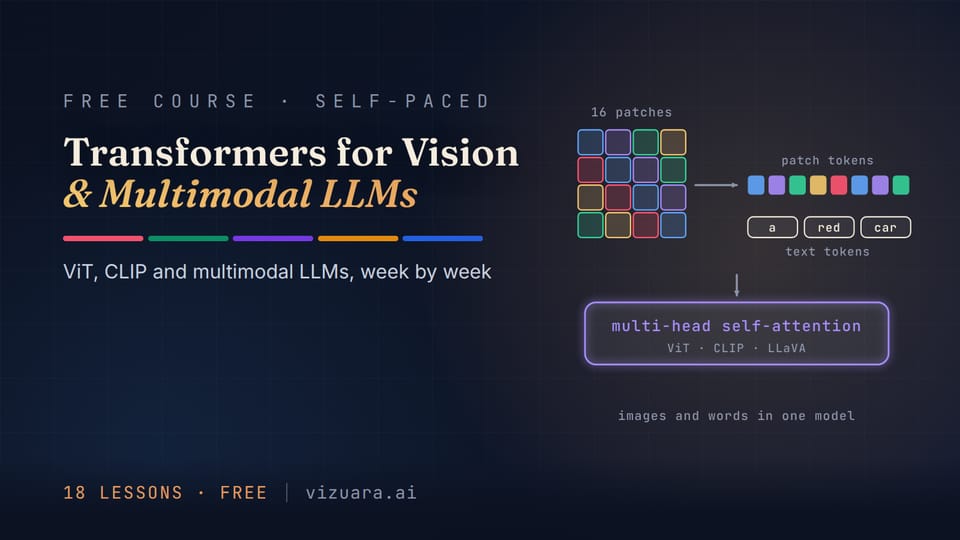
  11. Transformers for Vision and Multimodal LLMs [FREE]

    Fifteen recorded sessions on how the transformer moved from language into vision, and how vision and language are combined in multimodal models. You go from the limits of recurrent networks to self-attention, then build and study the architectures behind modern computer vision: ViT, DeiT, Swin, DETR and SAM, and finish with cross-attention for images and video. What you will learn From RNNs and Bahdanau attention to self-attention with trainable query, key and value weights Multi-head attention, naive and efficient, with the weight-split implementation Vision Transformer patch embedding in PyTorch, DeiT and knowledge distillation Swin Transformer shifted windows, DETR object queries and Hungarian matching, and Segment Anything CLIP-style contrastive learning, a nano vision-language model, and cross-attention in multimodal LLMs What is included 17 lecture recordings, about 34 hours of video Course end test Who it is for Data scientists, ML engineers and researchers who know basic deep learning and want to work with transformers in vision and multimodal settings.

    18 lessons 34h 20m
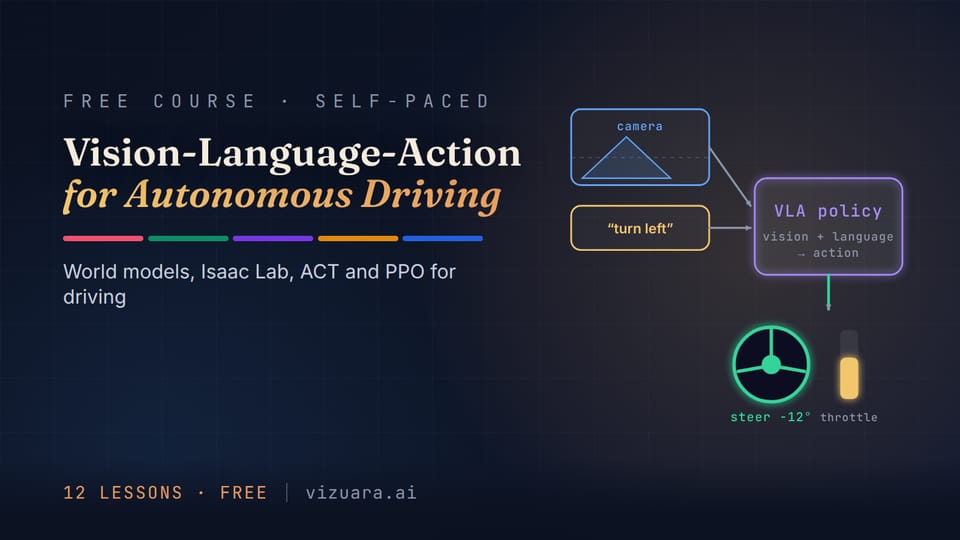
  12. Vision-Language-Action for Autonomous Driving [FREE]

    Build a complete vision-language-action system for autonomous driving, from camera input to control on a real robot car. Most courses stop at models or simulations. These eight recorded sessions follow the full stack that self-driving systems use: perception, language-driven reasoning, and action, with the hardware, noise and latency that come with it. What you will learn Why vision alone is not enough and how language gives a driving policy structure The Action Chunking Transformer (ACT) and its implementation in NVIDIA Isaac Lab Connecting a robot car, collecting data, training and running inference World models for autonomous driving Reinforcement learning and PPO for driving, and code-as-policy with coding agents What is included Nine lecture recordings across eight sessions, about 15 hours of video Who it is for Engineers and students with some deep learning background who want to see robotics, language models and control come together in one system.

    12 lessons 14h 55m